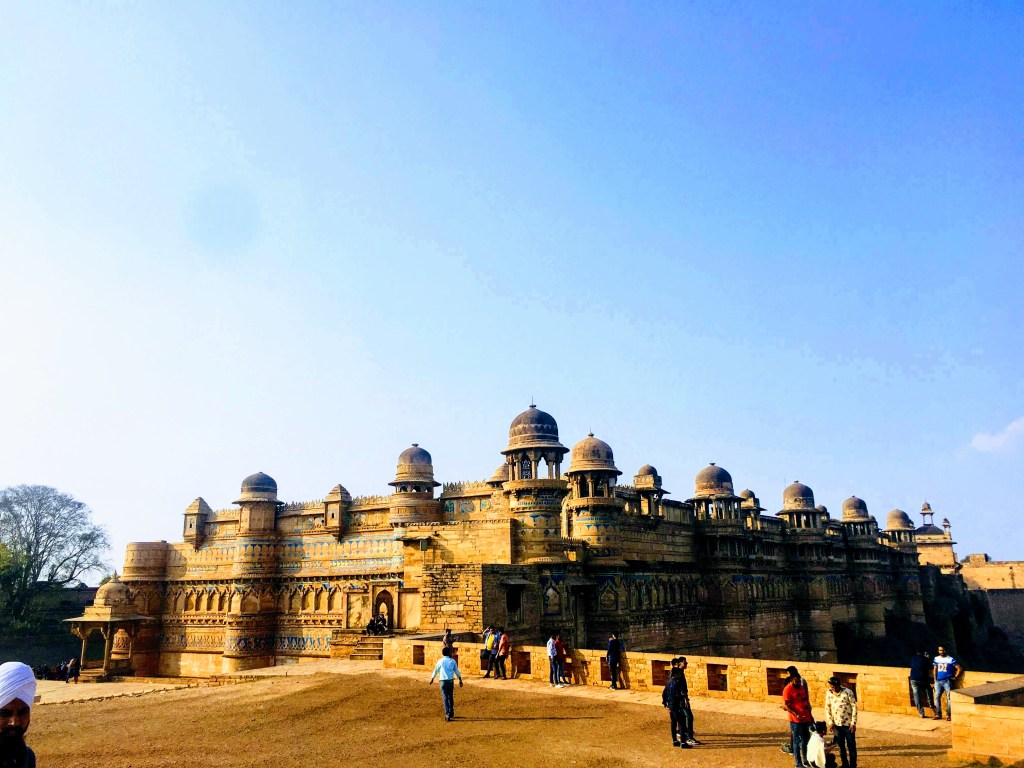
Gwalior fort itself was a small town near old Gwalior city. It has moss covered domes, giant faded doors, and carved walls. Gwalior fort was entitled as ‘Gibraltar of India’ by the Mughal Emperor Babur, it was called so because it provides panoramic sights of the old Gwalior city. The fort encloses several structures, temples and two main palaces. It’s believed that the fort already existed in the 10th century, and the inscriptions and monument found inside the fort specify that it may have existed as early as the beginning of the 6th century. Though the exact date of its construction is unknown as it was associated with a legend. According to a local legend, the fort is built by a local king Suraj Sen in 15th century and 16th century. The fort is built on a solitary rock hill called Gopachal.
Palaces within the Fort
There are several number of palaces within the fort including Man Mandir Palace, Gujari Mahal, Karan Mahal, Vikram Mahal, Jahangir Mahal and Shah Jahan Mahal.
Temples within the Fort
There are several numbers of temples within the fort including Siddhachal Jain Temple Caves, Idols on the Gopachal Hill, Teli-ka-Mandir, and Sas-Bahu Temple.
Other Important Structures
There are several other important structures that stands within the premises of the Gwalior fort including Garuda Monument, Chhatri of Bhim Singh Rana, Scindia School, and Gurdwara.
 Exotic_Vanu